The Sable Story
“Lindsey Inc is the team you bring in when the work matters.
At Sable, we are deliberate in selecting partners who can operate effectively in complex, highly regulated environments where safety, system integrity, and compliance are non-negotiable.
They played a critical role in preparing the OT infrastructure supporting our pipeline operations, including SCADA, leak detection, communications, backup control room readiness, and CRM/SOP development. In a high-consequence environment, Lindsey brought strong technical depth, discipline, and a clear focus on risk and operational readiness.
A partner we trust when it matters.”
— Lance Yearwood
Vice President
Pacific Pipeline Company / Sable Offshore Corp.
Shared with permission.
what lindsey can do for you
You’ve likely seen the headlines: after months of substantial automation improvements, critical infrastructure upgrades, and regulatory hurdles, the Las Flores Pipeline is up and running. It sat unused since 2015, and just two years ago, our team took on the challenge of renovating its IT/OT infrastructure to bring this asset online.
The regulatory environment was complex and controversial, but at Lindsey, our number one focus was safety, both to the environment and personnel. The pipeline restarted meeting all of the regulatory (DOT/PHMSA), state waiver, technical restart requirements, pipeline automation improvements, leak detection requirements, communications redundancy requirements, automated shutdown requirements, CRM and OQ requirements; truly a testament to the operations and technical delivery teams and the tremendous amount of effort and activities involved.
Here’s how the team at Lindsey made that happen.
Mid 2024
Sable was in the early stages of planning for the purchase, repair, and restart of the Exxon 901/903 Pipelines, commonly referred to as the Las Flores Pipeline System. The team at Sable was looking for a partner to take on all of the regulatory and compliance, restart preparation and planning, control systems implementation, leak detection, communications, infrastructure, and control room build out for the safe restart of the pipeline to deliver product from the Santa Ynez Unit to Pentland. The Lindsey team received an introduction from our executive advisor who had previously worked with Sable’s operations manager. Along with our key industry partners AVEVA, CRT Services, MetroWireless, Evosite, NetworkCraze, Meriplex, and GDT, we delivered; working alongside Sable to complete and now support a PHMSA ready 24/7 pipeline control room and associated control systems infrastructure.

Control Room and SCADA Selection

We initially worked with Sable leadership to advise on a suitable SCADA and leak detection system to deploy to meet the restart consent decree requirements, bringing AVEVA to the table for ‘best of breed’ control system applications that are deployed across all of the majors in the industry. In a collaborative meeting in 2024, Lindsey and AVEVA walked through the various regulatory and compliance, pipeline operations, control systems, leak detection, cyber security, and infrastructure/communications requirements that are necessary for successful and safe pipeline startup and operations, highlighting the timeline needed for a full turn key SCADA and control room build out to meet the restart contract timeline. Having collective decades of experience in this industry, our team was confident that we could deliver while keeping environmental and personnel safety front of mind.
While these discussions and decisions around control systems and architecture were ongoing, our team provided consultancy to determine the best suitable location for primary and backup control center operations, walking down several suitable locations for the primary control center and providing a cost / risk benefit analysis for each location to accommodate continuous controller occupancy and pipeline control center operations. Once the location was finalized, the team provided detailed specifications (mechanical, electrical, plumbing, and facility requirements) to the general contractor (GC) and worked alongside the GC to ensure that the control center footprint itself met the rigorous requirements for 24/7 operations. Every detail was thought through; including room layout, console placement, lighting, HVAC, backup power and UPS integration, fatigue mitigation, communications and data pathways, access control, and life-safety considerations… even down to the custom embroidery on the Iron Horse chairs for the controllers.
Rather than simply adapting conventional office space for pipeline operations, Lindsey helped deliver control room spaces aligned with PHMSA Control Room Management requirements and applicable API guidance
Field Assessments and Communications
Once the pipeline was available for walkdowns, Lindsey performed comprehensive field assessments across pipeline sites, block valve locations, and pump stations to evaluate communications paths, power availability, environmental conditions, and site-specific infrastructure constraints. Each location was reviewed with an operational mindset to understand how best to support continuous monitoring, reliable data flow, and long-term maintenance. Based on these assessments, the team developed redundant communications strategies designed to maintain 24/7 operational visibility for safe and reliable pipeline operations while working within site power limitations and practical field conditions.
During these evaluations, Lindsey also helped resolve practical challenges involving remote telemetry, data transport, protocol compatibility, and data handshakes between upstream and downstream parties, working through integration issues to help ensure accurate and timely information exchange across operational boundaries. In addition, Lindsey leveraged industry relationships to provide warm introductions to key partners, helping source critical components, and provide specialized metering and measurement expertise.

OT Infrastructure and Applications

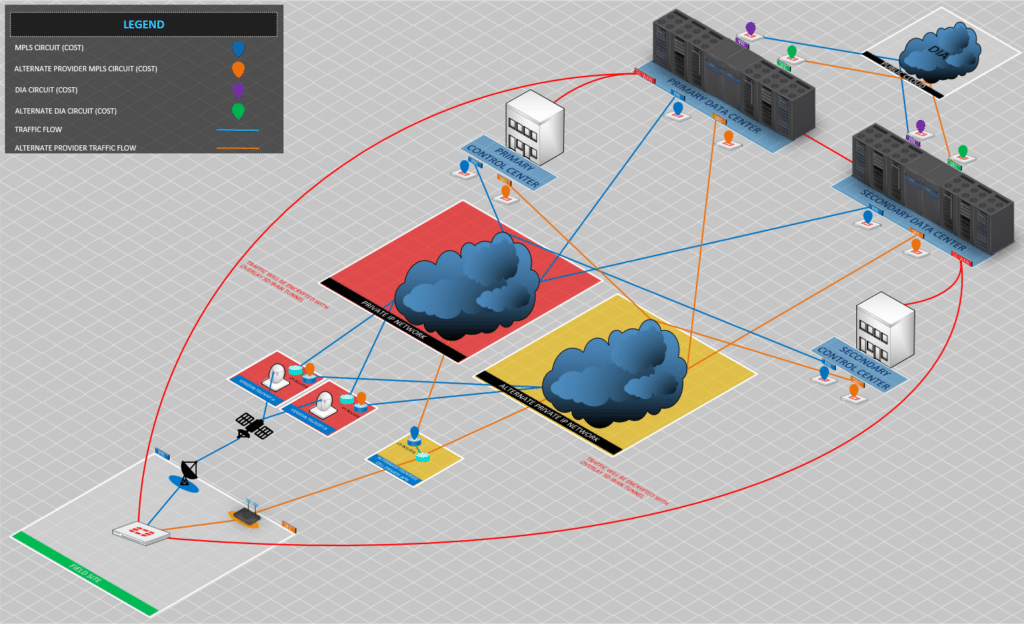
While field communications planning progressed, the infrastructure teams designed a fully redundant, Purdue Model (PERA) industrial control system (ICS) hosting environment and SD-WAN network to support the AVEVA Enterprise SCADA system, AVEVA leak detection system, PI systems, and the required cybersecurity, maintenance, monitoring, and support applications for this regulated environment.
After approval from Sable and AVEVA, the OT System and Network teams began procurement, provisioning, and buildout aligned to the Purdue model. Timelines were critical. While long-lead items were pending, equipment delivered to the Lindsey facility were staged in our lab and configured to the approved architecture so additional devices could be sequentially staged, tested, and validated as they arrived.
Once the first data center environment was ready, secure remote access enabled the Lindsey and AVEVA application teams to begin deployment of controls, compliance, operations, and administration applications. While AVEVA managed baseline installations, the Lindsey team developed API-compliant displays with Sable leadership and control center staff, including SCADA navigation, summary displays, reports, and field point-to-point checkout procedures.
With all of these strategies deployed, we were able to have the core system and network ready for commissioning in 11 months, including lead time for all hardware procurement.
Project Management and Coordination
Even before putting pen to paper on the SCADA and control room initiatives, Lindsey’s involvement with Sable actually began in the early stages of the overall pipeline repair and restart program. During this phase, Lindsey supported the broader coordination of daily field repair activities needed to advance the pipeline toward restart readiness.
This support included helping manage and track the day-to-day field repair schedules across repair digs, valve work, station activities, one-calls, and related construction and inspection tasks. Lindsey also supported development and maintenance of daily executive reporting used to communicate field progress, outstanding work, resource deployment, and emerging issues to project leadership. These reports consolidated repair status across multiple segments and work fronts, including percentage-complete tracking, daily work accomplishments, landowner/interface information, and activity status for stations, MOVs/check valves, pump stations, and repairs across the line.
In practice, Lindsey served as a coordinating bridge between field execution, project leadership, and the parallel control system and operational readiness efforts. This helped Sable maintain visibility into how repair progress, station work, valve installations, communications readiness, and control room preparations were converging toward startup.
In a program with many moving parts and multiple contractors, Lindsey’s role extended beyond technical delivery to include structured progress tracking, cross-functional coordination, schedule visibility, and executive-level reporting to support decision-making throughout the repair and restart effort.

Control Room Management and Training Support

Lindsey also supported Sable’s Control Room Management (CRM) program development toward CFR 195 while also preparing controller training materials, qualifications, and onboarding programs during active pipeline repair activities.
To support readiness before the permanent control room was available, Lindsey engineered a full simulator-based training environment using the AVEVA trainer console. A complete console was assembled in Lindsey’s Houston lab, where controllers completed three weeks of realistic “on-the-board” simulation training using modeled pipeline hydraulic data and actual console workflows. This hands-on environment enabled operators to train, qualify, and build confidence ahead of startup.
Once training was complete, the simulator console was carefully disassembled, packaged, and shipped to California in advance of final control room readiness, supporting a smooth transition into the live operating environment.
Commissioning and Failover Validation
Ahead of startup and during hydrotesting, we supported pre-commissioning activities by validating each all communication paths back to the primary data center and control environment. The team performed systematic failover testing across each communications link—from field devices to the data center and from the data center to the control room—to confirm that primary and backup paths operated as designed before live commissioning began. The team also worked to support pipeline controllers and field I&E staff during all point-to-point checkouts.
Lindsey also executed failover testing within the hosting infrastructure by simulating a rack failure and verifying successful transition to the secondary rack. These efforts confirmed the resiliency of the control system environment and readiness for reliable operations at startup.
Innovative Field Power and Controls Solutions

The project included unusual field constraints related to remote power, communications, and visibility limitations at certain locations. Lindsey helped spearhead the development of an innovative field solution that addressed the need for buried or low-profile controls and instrumentation, including the UPS power equipment, while still maintaining communications, and controls operability, without affecting ongoing pipeline operations. The resulting approach incorporated hardened field enclosures, battery/charging provisions, and redundant communications methods suitable for these operating constraints.
Post-Startup / Operations Support
Following startup, Lindsey deployed its ‘Premier’ level, 24/7 operations support program to provide ongoing support for Sable’s infrastructure, communications, and control room operations. This support model is centered on system reliability, rapid response, and proactive maintenance, with routine monitoring, patching, backups, performance reviews, and preventive care designed to minimize risk and maximize availability.
As operations continue, Lindsey serves as an extension of the Sable team by providing technical expertise, troubleshooting assistance, and change management support for critical systems. The team also supports periodic assessments, regulatory reviews, and internal audits of the control environment against approved cause-and-effect matrices, operating procedures, and control narratives to help ensure continued compliance, operational readiness, and safe, reliable pipeline performance.
